Last updated: 1 August 2026
Artificial intelligence has become one of the most widely used terms in recruitment technology.
Almost every new platform now claims to use AI. Some genuinely use advanced technology to understand information, identify patterns and produce useful recommendations. Others use simpler automation to complete repetitive tasks more quickly.
But for the Managing Director of a recruitment agency or executive search firm, this is not the most important distinction.
The real question is much simpler:
Will this technology help our consultants make better decisions, move faster and generate more revenue?
There is a tendency to describe AI as advanced and automation as basic. That is misleading.
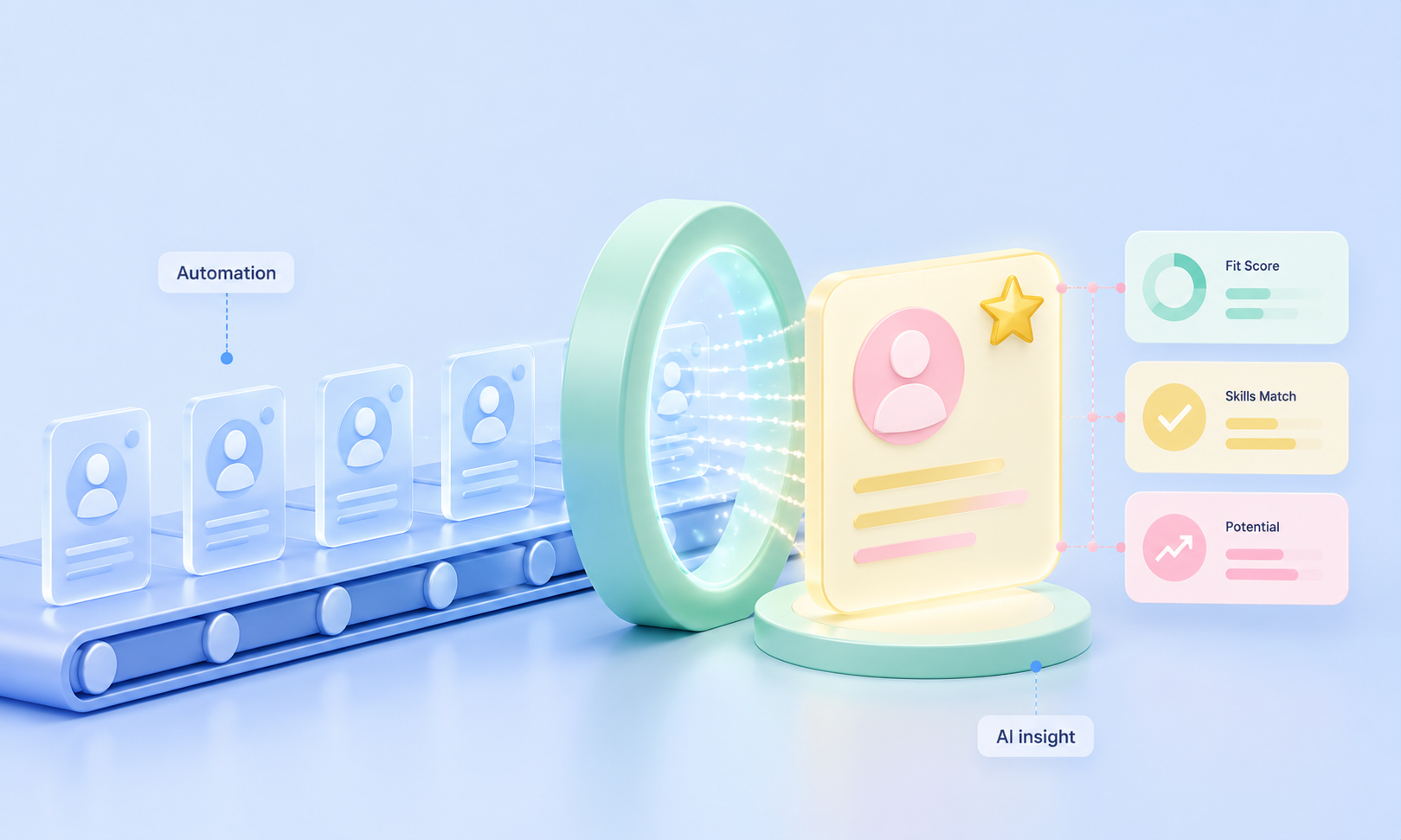
Automation follows a process to complete a task. For example, it might update a candidate record, send a reminder, move information between systems or trigger an outreach sequence.
AI can work with less structured information. It may help interpret a job description, identify relevant candidates, summarise research, suggest suitable companies or draft personalised messages.
Most useful recruitment platforms combine both.
The AI helps understand the request or information. The automation helps complete the work.
Recruitment leaders therefore should not dismiss a platform simply because part of it uses automation. A dependable automation that removes hours of administration can deliver significant value.
Equally, a product should not be purchased simply because the vendor calls it AI.
Before asking how sophisticated the technology is, ask what problem it solves.
Does it help your consultants:
A product that solves one or more of these problems consistently may be a worthwhile investment, regardless of the technical terminology used to describe it.
Recruitment leaders do not need to become AI engineers. They do, however, need to ask sensible commercial questions.
The provider should be able to explain the benefit in straightforward recruitment language.
Be cautious when the answer relies on technical descriptions rather than practical outcomes.
A clear answer might be:
“It helps your researchers identify relevant senior candidates across multiple sources and create an initial talent map more quickly.”
An unclear answer might contain impressive language but leave you unsure what your team will actually be able to do differently.
A controlled demonstration is more useful than a long technical presentation.
Give the provider a genuine role, market or client profile. Ask them to show how the platform would support the work.
Look at the quality of the results, not just the speed of the demonstration.
Are the candidates relevant? Are the companies appropriate? Is the information useful? Would your consultants trust it enough to continue their research?
No recruitment tool will produce perfect results every time. The aim is to establish whether it gives your team a stronger starting point.
Recruitment AI is only as useful as the information it can access.
Ask whether the platform uses public information, licensed data, your own CRM records or a combination of sources.
You should also understand how recently the information was collected or updated.
The provider may not be able to disclose every commercial data agreement or technical process. It should, however, be able to give you a clear and credible explanation of where its information comes from and where coverage may be limited.
AI should support professional judgement, not replace it.
Your consultants should remain responsible for deciding:
The platform should make it easy for a recruiter to review, edit, reject or refine its suggestions.
This is particularly important when the technology is being used to compare or shortlist candidates.
Be cautious of claims such as “100 per cent accurate”, “completely unbiased” or “fully replaces the recruiter”.
All technology has limitations. Candidate information may be incomplete. Employment details may have changed. Some sectors and regions will have better data coverage than others. An apparently suitable person may not meet an important requirement that is not visible online.
A trustworthy provider should explain where the platform is strongest, where additional checks are needed and what the user remains responsible for.
360AI, for example, describes its outputs as research that should be verified and states that its tools are designed to support professional judgement rather than replace it.
Even a powerful platform will fail if consultants find it difficult to use.
Consider whether the technology can work alongside your existing ATS, CRM, email and communications tools.
Ask how much training is required, how quickly new users can become productive and what support is available.
You should also establish whether consultants need to switch between several systems or whether the platform can bring useful information and actions into one workflow.
The objective should be adoption across the business, not impressive technology that only one enthusiastic user understands.
Agree on the outcome you expect before beginning a trial or implementation.
Useful measures might include:
The correct measures will depend on the product and the problem it is intended to solve.
A sourcing platform should not be measured in exactly the same way as a CV screening tool or a business development platform.
Not every recruitment technology use case carries the same level of risk.
A tool that helps draft an email, research a company or suggest possible candidates is supporting a recruiter’s work. The recruiter still reviews the result and makes the decision.
A tool that automatically rejects applicants or makes final hiring decisions requires much greater scrutiny.
Recruitment leaders should therefore consider how the output will be used.
For research, sourcing, market mapping and business development, the main questions are usually:
For candidate assessment and shortlisting, additional care is needed:
This is a more practical approach than applying the same technical checklist to every AI feature.
360AI combines AI, live data and automation to support common recruitment and executive search activities.
Depending on the product being used, the platform is designed to help teams source candidates, map markets, identify prospective clients, review CVs, refresh CRM information, monitor relevant market signals and support personalised outreach.
The purpose is not to remove the recruiter from the process.
It is to give recruiters a faster and more informed starting point, reduce repetitive work and help them concentrate on the parts of recruitment where human expertise matters most: judgement, relationships, influence and trust.
Users should still review the available information, confirm important facts and decide what action to take.
There are some straightforward warning signs when evaluating an AI recruitment provider.
Be cautious when a provider:
These warning signs matter more to most recruitment businesses than knowing the exact technical category of every component inside the platform.
Do not buy a recruitment platform because it has an AI label.
Do not reject useful automation because it sounds less advanced.
Instead, ask:
Does it help our consultants find better information, make stronger decisions and complete valuable work more quickly, while keeping our people in control?
A credible provider should be able to answer that question in plain language and demonstrate the answer using a real recruitment scenario.
That is the difference between technology that looks impressive and technology that genuinely improves a recruitment business.
In 2024, the US Securities and Exchange Commission brought fraud charges against the founder of Joonko, a recruitment startup that had raised tens of millions of pounds from investors. The allegation: she had claimed the platform ran on "seven different AI algorithms" that, according to the SEC, it didn't actually have. A parallel criminal case in New York alleged she used similar false claims to secure roughly $27 million in investment. The SEC's enforcement director at the time put it bluntly: this was old-fashioned fraud wearing new buzzwords like "AI" and "automation."
These were allegations, not a final court finding on every detail. But the lesson for anyone buying recruitment software holds regardless: don't take "AI-powered" on trust. Ask the vendor to show their working.
Fixed rules. Someone writes the instructions in advance: "if the candidate doesn't have a valid licence, reject." The system does exactly what it's told, nothing more. It only changes when a human changes the rule. Useful, simple, easy to audit, but it can't spot patterns a human hasn't already thought to write down.
Machine learning. The system is shown lots of past examples (CVs, placements, outcomes) and learns patterns from them, then uses those patterns to score or rank new candidates. This is genuinely AI. It can spot things a rule-writer would miss, but it's only as good as the data it learned from, and it can quietly repeat old biases if nobody checks it.
Generative AI. This is the technology behind tools that draft outreach messages, summarise a call, or turn a plain-English request like "find me a senior FP&A candidate in Manchester" into an actual search. It's excellent at saving time on writing and searching. It is not, by itself, a hiring decision-maker, and no credible vendor should present it as one.
Most serious recruitment platforms, 360AI included, use a mix of all three. That's not a weakness. It's normal. What matters is whether the vendor can tell you which part does what.
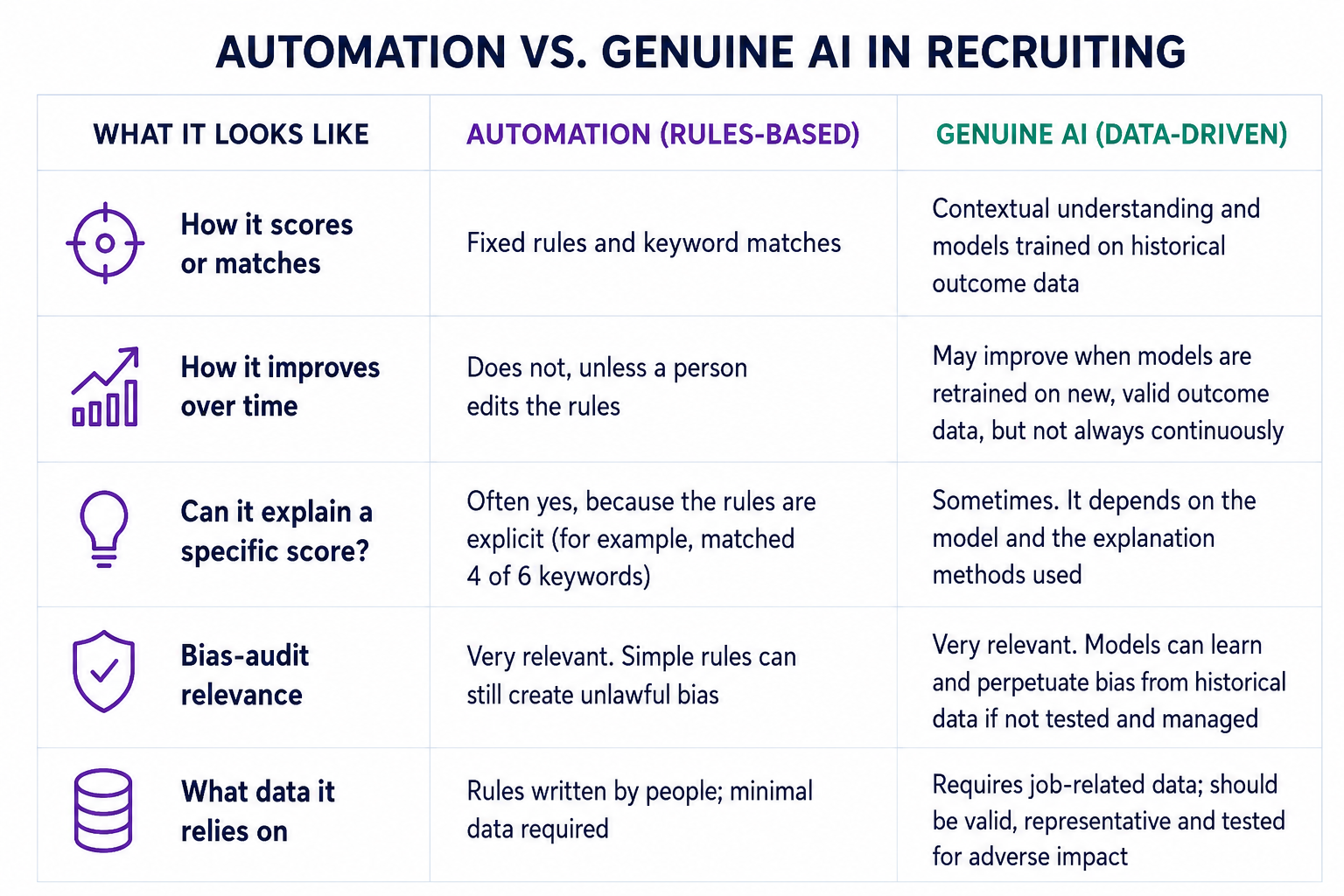
A vendor should be able to answer these questions without treating confidential source code as the only possible evidence. Useful evidence can include model cards, validation reports, data sheets, audit summaries, version histories, test results and a controlled product trial.
Sam Aria is the Founder and CEO of 360AI, a real-time talent and market intelligence platform for the recruitment industry.
This article is a practical market analysis. Any use of personal data for recruitment should be assessed against applicable data-protection, employment and confidentiality requirements.
The claims in this article are supported by the following primary and official sources:


AI built to think like a recruiter.