
Last updated: 31 July 2026
Executive search has always depended on finding leaders who are not applying and may not be visibly looking.
That has not changed.
What has changed is the speed at which a search team can understand the market around a senior appointment. AI can help collect and organise public information across companies, leadership histories, board appointments, regulatory filings, conference programmes and credible news sources.
That makes the research phase faster and more current. It does not make the final judgement automatic.
In 2026, that distinction matters more than ever. Boards are not simply replacing leaders at record speed. The latest US data shows a more cautious succession market, with organisations favouring stability while still managing a substantial volume of leadership change.
The opportunity for executive-search firms is therefore not to automate the human parts of the process. It is to build a clearer market view sooner, then spend more time on interpretation, confidential outreach and assessment.
Challenger, Gray & Christmas recorded 782 CEO exits at US organisations through May 2026, down 24% from 1,028 over the same period in 2025.
Within publicly traded companies, 155 CEOs departed during the first five months of 2026, compared with 218 a year earlier.
The organisation described the pattern as a shift towards stability rather than forced change. Retirements and voluntary step-downs accounted for most departures, while terminations and board disputes remained comparatively rare.
That is a more useful picture for executive search than simply repeating last year’s record total.
Leadership movement remains substantial, but the market is not uniformly accelerating. Some boards are retaining proven leaders for longer, while others are managing planned succession, transformation or retirement.
This creates a different research challenge. Search teams need to understand not only who has moved, but where succession risk, internal readiness and external optionality may be developing.
Heidrick & Struggles’ 2026 Route to the Top research analysed 1,664 sitting CEOs across 28 markets.
That scale illustrates why executive market mapping cannot be reduced to a single database or profile search. Senior leadership evidence is distributed across company websites, regulatory records, board announcements, professional bodies, conference programmes, industry reporting and other public sources.
A LinkedIn profile can be useful, but it is only one part of the evidence.
The objective is not to identify the most visible executive. It is to understand the full plausible market, including leaders whose public profiles are incomplete, restrained or out of date.
AI can reduce the manual effort involved in collecting, organising and comparing public professional information.
It can help a research team:
This is useful because leadership markets are dynamic, but the available evidence is fragmented.
AI can make that evidence easier to review. It cannot decide what it means without context.
A useful signal is a public, job-relevant event that deserves human attention.
Examples may include:
A signal is not proof that someone wants to move.
It should not be treated as a hidden declaration of intent, and it should never replace verification or direct conversation. Public information can be incomplete, delayed or open to several interpretations.
The role of a signal is to prioritise research. The role of the search consultant is to decide whether the evidence is relevant, accurate and meaningful.
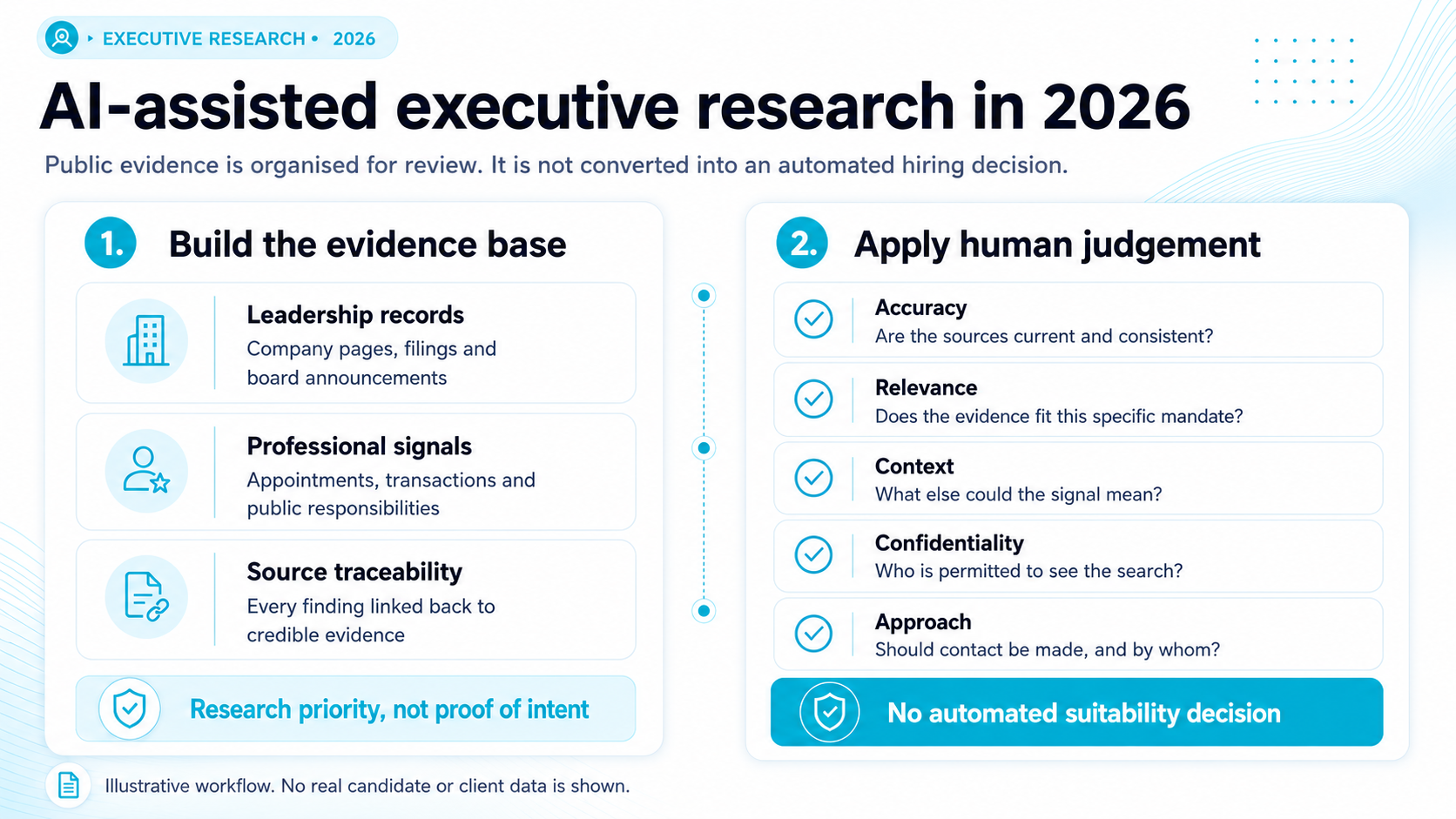
AI should not make an automated suitability decision about a senior candidate.
It should not infer sensitive personal characteristics, manufacture certainty from weak data or present incomplete public information as a definitive judgement about someone’s intentions.
It should not send confidential outreach without human control.
And it should not weaken the information controls around a live search.
Executive-search technology needs:
A tool that surfaces a candidate faster is useful.
A tool that exposes a confidential name, client or succession plan to the wrong person is dangerous.
Confidential executive search depends on judgement about what can be said, to whom, at what point and through which channel.
A replacement search may involve an incumbent who does not know that succession is being considered. A candidate may need assurance that an exploratory conversation will not reach their employer. A client may require strict limits on who can view the mandate or longlist.
Technology can support those controls, but it cannot create trust.
The search consultant still decides:
Those decisions remain central to the value of executive search.
Building the market map
AI can reduce the time spent collecting and structuring public information. A human still has to define the market, challenge assumptions and decide who belongs on the longlist.
Monitoring leadership movement
Technology can track public events more consistently. A human still has to distinguish a meaningful development from noise.
Assessing an executive
AI can organise evidence. It cannot reliably judge leadership presence, motivation, cultural context or how someone will operate with a particular board.
Candidate approach
Technology can help prepare research. The conversation, discretion and credibility still come from the search consultant.
Confidentiality
Software can enforce permissions and audit trails. The responsibility for protecting the search remains human.
The competitive advantage is not simply having AI.
It is using it to redirect time towards the work that clients are paying experienced search professionals to perform.
A research process that is faster and more current can create more time for:
The strongest model is not AI instead of executive search.
It is AI-assisted market intelligence combined with human judgement, relationships and discretion.
That is the balance behind 360AI’s AI Headhunter and Signal Tracking capabilities: compress the research, preserve the judgement.
Where has AI genuinely improved executive-search work in your experience, and where should the process remain deliberately human?
Sam Aria is the Founder and CEO of 360AI, a real-time talent and market intelligence platform for the recruitment industry.
This article is a practical market analysis. Any use of personal data for recruitment should be assessed against applicable data-protection, employment and confidentiality requirements.


AI built to think like a recruiter.