
Last updated: 5 October 2026
Most of the conversation about AI in recruitment focuses on candidates: sourcing, mapping and assessment. Far less attention is paid to the other side of the business: how executive search and recruitment firms identify opportunities, build client relationships and win mandates.
That is a commercial blind spot.
Bullhorn's 2026 GRID Recruitment Industry Trends Report found that recruitment agencies using AI at any stage of their workflow were 3.5 to 4.5 times more likely to have grown revenue in 2025. That finding does not isolate business development or prove that AI causes revenue growth. But it raises a worthwhile question for search leaders: are firms applying AI to the activities that help them win work, or concentrating almost entirely on delivery?
In retained executive search, the opportunity often exists before a formal brief. A CEO departure, a change of ownership or a new chair can create a leadership requirement months before a search process begins. By the time a mandate is formally discussed, the client may already have a shortlist of firms in mind.
Relationships determine who gets considered. The challenge is recognising when those relationships are worth activating.
AI will not build a board-level relationship on a partner's behalf. It can, however, help a firm identify relevant market changes earlier, assess their significance and direct attention towards the opportunities most worth pursuing.
For search firms looking to grow without simply asking partners to spend more time on BD, that is where the opportunity lies.
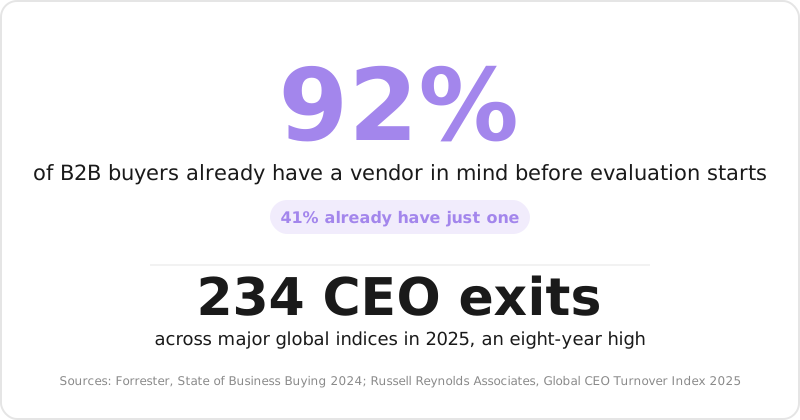
Forrester's 2024 business-buying research found that 92% of B2B buyers had at least one vendor in mind before formal evaluation, while 41% had a single preferred vendor. These figures concern B2B buying generally, rather than executive search specifically, but the principle is relevant: supplier preferences often form before a formal process begins.
In executive search, that preference is shaped by trust, reputation, relevant experience and access to the right people. A chair considering a new CEO, or a private equity operating partner anticipating a CFO transition, is unlikely to start with a blank sheet of paper.
The firms that enter the conversation early are often those that already understand the client, its leadership team and the challenges ahead.
The number of potential triggers is substantial. Russell Reynolds Associates' Global CEO Turnover Index recorded 234 CEO departures across the listed indices it tracks in 2025, an eight-year high and the second record year running. A CEO transition can also prompt a review of the wider leadership team, creating potential second-order requirements, including at CFO level.
None of these events guarantees a search mandate. Some succession plans are internal, some appointments are already covered by existing relationships, and some changes never become external searches.
But each event can change the probability of a future requirement. The commercial question is whether a firm recognises that change early enough to respond intelligently.
The mandate may be won before the brief, but only if the firm is relevant before the brief exists.
The value of AI in search BD is not simply generating more leads. It is improving the firm's ability to monitor its market, interpret what is changing and decide where partner attention is most valuable.
Most established search firms already do some of this. Partners follow their sectors, researchers monitor companies, and relationships surface information that never appears in a public announcement.
The limitation is consistency. Monitoring depends on individual habits, personal networks and the time available between live assignments. A partner may know every meaningful development in their closest accounts while missing a leadership change in a company they have not spoken to for six months.
Across a firm with multiple practices, geographies and hundreds of relevant organisations, those gaps become harder to manage.
AI-enabled market intelligence can help by continuously monitoring relevant public business developments, including:
The system's job is to surface relevant developments and connect them to the right accounts and decision-makers. The partner's job remains to judge what the development means, whether the firm has a credible reason to engage, and how to approach the relationship.
That distinction matters. An alert is not an opportunity, and an opportunity is not a mandate.
The advantage is not that AI identifies events no experienced partner could recognise. It is that a structured system can help the firm identify more relevant events consistently, across a wider set of accounts, while there is still time to act.
Not every development warrants an approach. Treating every alert as a sales opportunity creates noise, wastes partner time and risks damaging relationships.
A more useful approach is to classify signals by their potential commercial significance, then assess them in context.
The following framework is designed for executive search. It is a practical operating model, not a statistically validated prediction of which events will produce mandates.
The priority depends on context, not just the event.
An unexpected CFO departure at a company where the firm has a strong chair relationship may justify prompt attention. The same announcement at a company with no relevant relationship, an established incumbent search partner or an obvious internal successor may warrant research rather than outreach.
Signals also become more informative when they are considered together. A new CEO appointment alone may be worth monitoring. A new CEO, a refinancing requirement and a restructure within the same period may suggest a more significant change in the leadership agenda.
Multiple signals do not prove that a search will happen. They provide additional context for deciding where further investigation is worthwhile.
Two further considerations matter in executive search.
First, urgency does not mean immediate solicitation. Leadership transitions can be sensitive, and a board may already be managing a confidential process. A credible market perspective is often more valuable than a rapid capabilities pitch.
Second, signals that matter in other parts of recruitment can mean something different in executive search. A newly appointed Head of Talent is often treated as a buying signal by contingent agencies, because a new talent leader may review supplier relationships. For a search firm, the same appointment is ambiguous: it could mean the company is building its own executive hiring capability, starting a wider transformation or simply replacing someone who left. It only becomes meaningful alongside what the firm already knows about the client.
The objective is not to contact every company experiencing change. It is to identify the situations where the firm has both a plausible opportunity to add value and a credible reason to engage.
Consider a company where a new CEO has joined and the CFO subsequently leaves.
A generic approach might read:
"I noticed some changes in your leadership team and wanted to introduce our CFO practice."
It communicates little about the sender's understanding of the situation. It could have been sent to almost any company.
A more considered approach might read:
"With the CFO transition following the new CEO's arrival, and the refinancing due next year, the leadership requirement may extend beyond a like-for-like replacement. The question could be which CFO has the experience to partner the CEO through the next phase. We've mapped executives who have led similar transitions in your sector and would be happy to share our perspective if useful."
The second approach is more relevant because it connects observable developments to a plausible business challenge and offers something useful in return.
It also avoids pretending to know the client's plans. The language is deliberately conditional: the firm has identified a potential issue, not assumed that it understands a confidential brief.
That is the difference between signal-led BD and automated prospecting.
The signal provides the reason to investigate. Research provides the context. The relationship determines whether and how to engage.
The same principle applies to research teams. Rather than building market maps only after a mandate is signed, researchers can prepare focused views of the leadership market for accounts where a credible opportunity is emerging. That work can make an early client conversation more substantive, while remaining useful even if no mandate follows.
The operational change is straightforward, but it requires discipline.
In a conventional BD routine, a partner may begin by recalling whom they have not spoken to, reviewing recent news and asking colleagues whether anything is happening in their accounts. The quality of the resulting activity depends heavily on memory and the information available that day.
In a signal-informed routine, relevant developments have already been collected and prioritised. The partner starts with a shorter list of accounts that warrant attention, rather than an undifferentiated list of organisations to contact.
For each priority account, the partner and research team should be able to answer four questions:
This also creates a clearer division of responsibility. Research monitors developments, validates information and prepares the relevant market context. Partners apply their judgement, use their relationships and decide whether to act. Someone must own the process of turning a relevant signal into a timely decision.
Without that ownership, even the best intelligence becomes another feed that nobody has time to read.
Before investing in more tools or expanding BD activity, firms should establish where their current process succeeds and where it breaks down.
Start with the retained mandates won in the past 12 months. Record how each originated: an existing relationship, a referral, an invitation to pitch or an identifiable market development that prompted someone to act.
Then review opportunities the firm learned about too late, including situations where a relationship existed but the relevant development was not recognised or acted on in time.
The aim is to distinguish a relationship problem from an intelligence problem, and an intelligence problem from a failure to act.
From there, establish a small set of measures:
These measures will not establish causation on their own. Mandate outcomes are influenced by relationships, reputation, competition, market conditions and many other factors. But they give a firm a practical basis for testing whether better intelligence improves its BD process.
The goal is not to maximise alerts, outreach or activity. It is to improve the quality of commercial decisions and understand whether those decisions contribute to winning work.
Three actions provide a sensible starting point.
1. Define the signals that matter to each practice.
A private equity practice, a board practice and a technology leadership practice will not prioritise the same developments. Agree which events deserve immediate investigation, which call for longer-term relationship development and which simply belong in the background intelligence.
2. Establish ownership and a response process.
Decide who monitors the market, who validates the information, which partner owns each relationship and how the firm decides to act. Intelligence only creates value when someone is accountable for the next step.
3. Make discretion and data governance part of the process.
Use information appropriately, assess the relevant data-protection requirements and ensure outreach is proportionate to the circumstances. Public availability does not automatically make every use of personal data lawful. Firms should assess their UK GDPR obligations, including the basis for processing, transparency requirements and individuals' rights. In executive search, discretion is part of the firm's reputation, not an afterthought.
For firms that want to put this approach into practice, 360AI Prospector monitors a wide range of market signals, including leadership exits, ownership changes and funding events. It connects them to the relevant decision-makers and helps prioritise the accounts most worth investigating.
The objective is not more outreach. It is better-informed conversations, at the point when they are most relevant.
Executive search will remain a relationship business. AI does not change that. What it can change is how consistently a firm recognises an emerging opportunity, how well it prepares for the conversation and how effectively it directs the attention of its most valuable people.
The firms that benefit will not necessarily be those with the most data or the most alerts. They will be the ones that combine timely intelligence with sound judgement, relevant expertise and trusted relationships.
A useful place to start is to look back at the mandates you won, and the ones you heard about too late. The difference may reveal where your next commercial advantage lies.
Sam Aria is the Founder and CEO of 360AI, a real-time talent and market intelligence platform for the executive search and recruitment industry. Connect on Linkedin.
This article is a practical market analysis. Any use of personal data for recruitment should be assessed against applicable data-protection, employment and confidentiality requirements.
The claims in this article are supported by the following primary and official sources:


AI built to think like a recruiter.