
Last updated: 21 July 2026
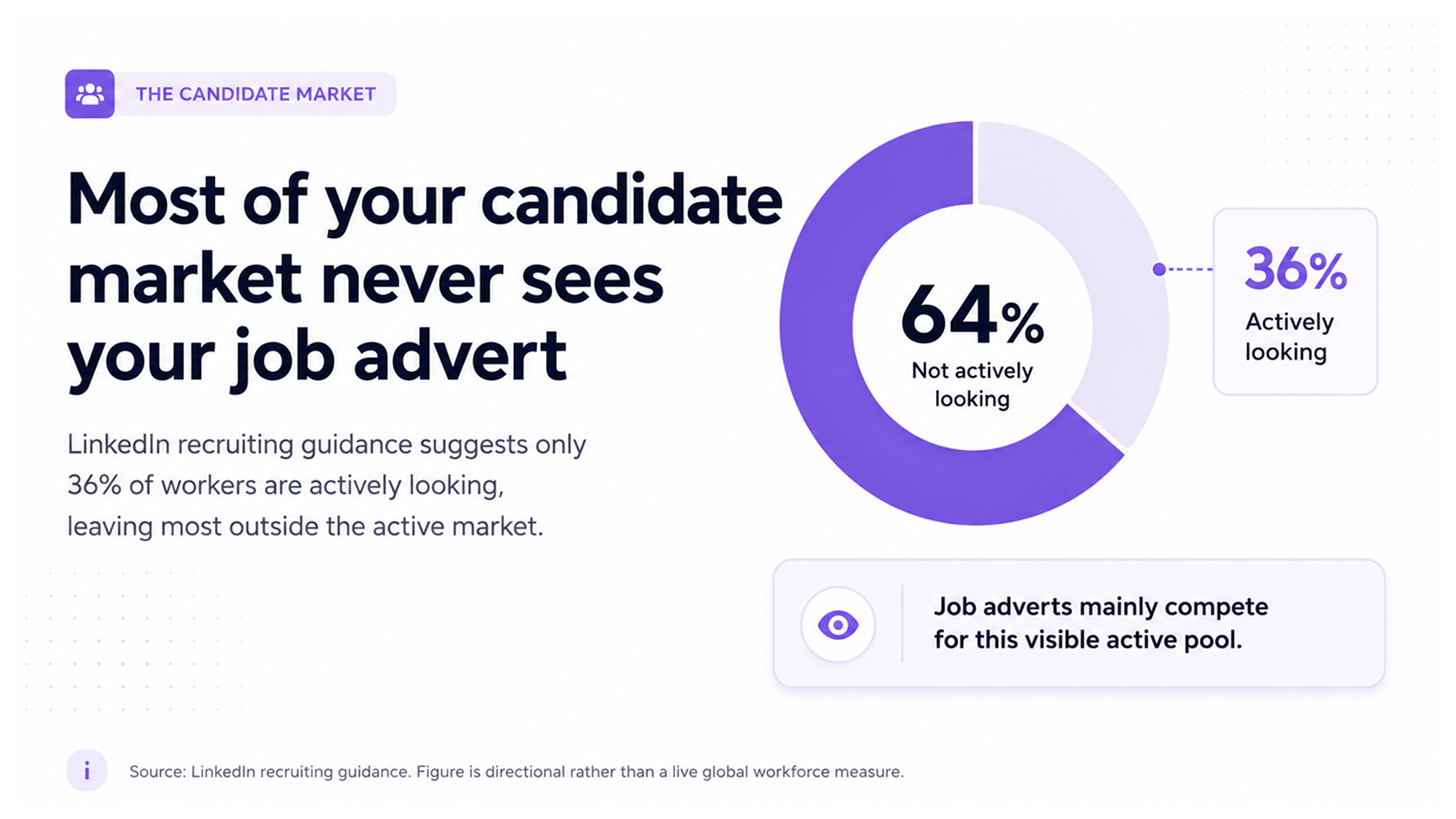
LinkedIn’s recruiting guidance says 36% of workers are looking for a new role, leaving 64% outside the active market. The underlying figure is not new enough to treat as a precise, real-time measure of the global workforce, but the practical point remains important: relying only on inbound applications means recruiting from a limited and highly contested part of the market.
I started 360AI after seeing this gap from inside recruitment. The strongest candidates were often not the people who had applied. They were people identified through market knowledge, referrals and direct research who were not actively looking but were willing to have the right conversation.
The recruitment industry has invested heavily in processing applicants faster. Far less attention has been paid to identifying relevant people before they become applicants.
A passive candidate is generally someone who is employed and not actively applying for jobs or regularly browsing job boards, but who may still be open to the right opportunity.
That definition covers very different levels of interest.
Some people are genuinely closed to a move. Others are content where they are but willing to listen. A third group may be considering a change without having created an obvious inbound signal.
Treating all of them as one segment leads to poor outreach. The useful question is not simply whether someone is “passive”, but whether there is credible evidence that a conversation may be timely and relevant.
It is also worth being careful with the familiar claim that 70% of the workforce is passive. That figure is widely repeated, but it comes from older LinkedIn research. LinkedIn’s current recruiting guidance uses a 36% active figure, implying 64% are outside the active market.
Neither number should be treated as a permanent law of the labour market. Activity varies by occupation, seniority, geography and economic conditions. What the evidence does support is that most workers are not actively searching at any one time.
ManpowerGroup’s global Talent Shortage Survey provides a separate view of the market: the share of employers reporting difficulty finding the skills they need.
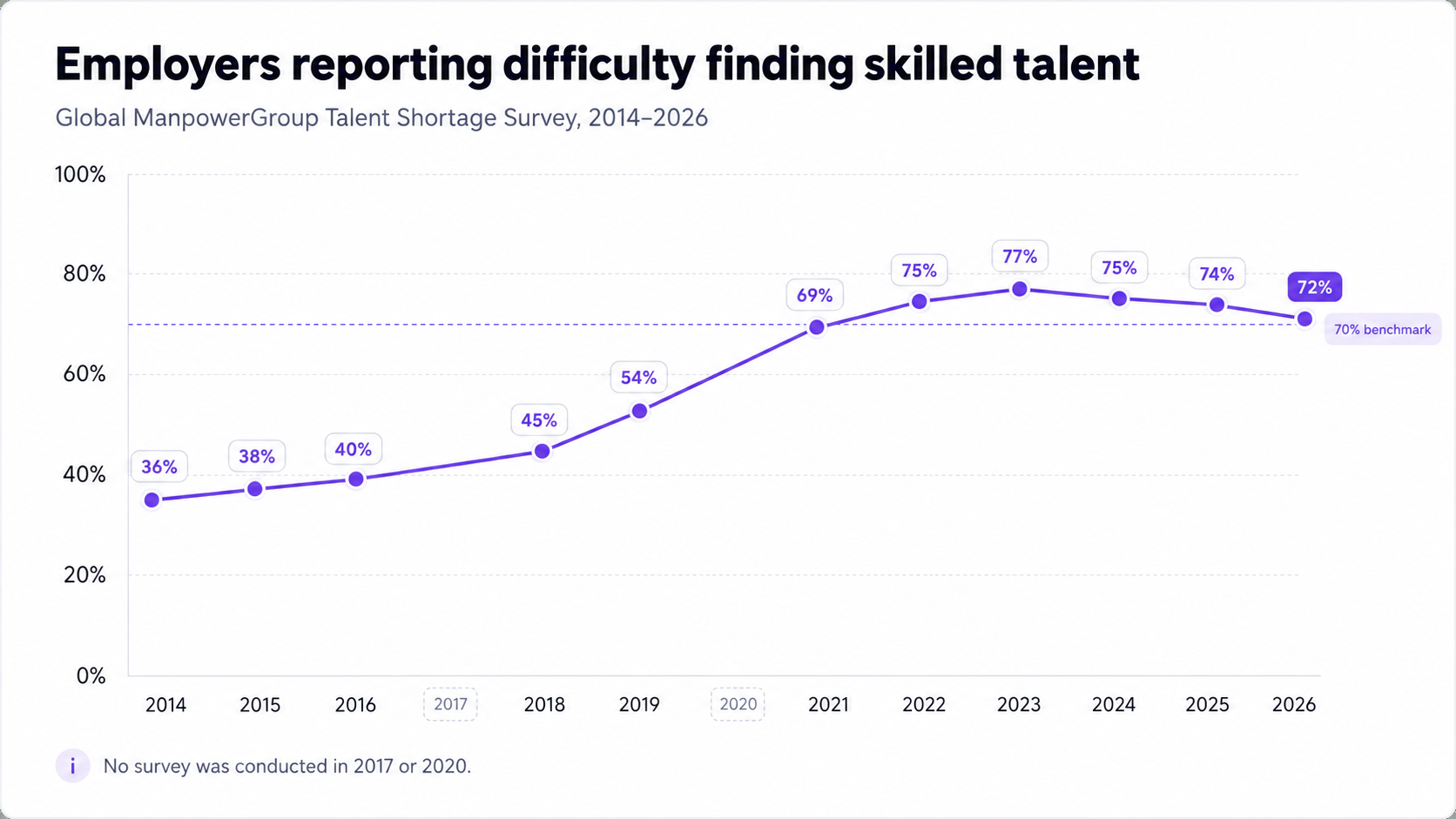
That figure rose from 36% in 2014 to 54% in 2019 and 69% in 2021. It reached 75% in 2022, peaked at 77% in 2023, then eased to 75% in 2024, 74% in 2025 and 72% in 2026.
The survey was not conducted in 2017 or 2020, so the series should not be presented as an uninterrupted annual measure.
The latest decline is encouraging, but 72% remains twice the 2014 level. Employers are still reporting substantial difficulty filling roles.
It would be too simplistic to say this shortage was caused by job-board-led sourcing. Skills mismatches, demographic change, location, pay, working conditions, training and changing job requirements all matter.
But sourcing strategy affects how much of the available market an employer can see. When organisations search only among current applicants, they can make an already difficult hiring market feel even smaller.
Signal-based sourcing starts with the relevant talent market rather than an applicant queue.
It identifies people with the required skills and experience, then uses lawful and job-relevant signals to decide who may be worth approaching. Those signals might include a recent role change, a newly acquired professional qualification, a public portfolio update, relevant professional activity or a known connection to the hiring organisation.
A signal is not proof that someone wants a new job. It is a reason to prioritise thoughtful research and potentially start a conversation.
This distinction matters. A profile update should not be treated as a hidden declaration of intent, and personal data should not be collected or interpreted without regard to privacy, accuracy and context.
Used responsibly, signals help recruiters prioritise the right people rather than sending the same generic message to everyone returned by a keyword search.
Job adverts and inbound applications primarily reach people already looking or sufficiently motivated to apply.
Referrals can reach both active and passive candidates, although their coverage is limited by the diversity and reach of the existing network.
Direct professional outreach allows recruiters to approach suitable people who have not applied, making it particularly useful for specialist, senior and difficult-to-fill roles.
Multi-source, signal-led research can broaden market visibility further, provided the information is relevant, lawful, accurate and used with appropriate human judgement.
No single channel reaches the entire market. The objective is not to abandon job adverts, but to stop treating them as a complete sourcing strategy.
Start by separating applicant management from market mapping.
Applicant management asks: who has applied, and who is qualified?
Market mapping asks: who could do the job, whether or not they have applied?
For difficult searches, build a clear view of the relevant companies, locations, skills, adjacent backgrounds and likely talent pools before deciding that qualified people are unavailable.
Then prioritise outreach based on fit and credible timing signals. Personalise the reason for contacting someone, explain why the role may be relevant and make it easy for them to decline.
Measure more than application volume. Useful measures include the proportion of the relevant market identified, outreach acceptance, response quality, qualified conversations and representation across the researched talent pool.
Finally, keep human judgement in the process. Signals can help order research, but they should not become opaque scores that exclude people or make employment decisions without meaningful review.
Job adverts remain valuable, particularly where there is a healthy supply of qualified active candidates.
The mistake is assuming that a weak applicant response proves the talent does not exist.
Sometimes the problem is the role, pay, location or employer proposition. Sometimes the skills genuinely are scarce. And sometimes the search has simply covered too little of the market.
A stronger sourcing strategy distinguishes between those possibilities before declaring a shortage.
That is the gap 360AI’s Talent Mapping capability is designed to address: helping recruitment teams understand the relevant market and identify suitable people beyond the applicant pool.
How different is the active-versus-passive balance in your own market? I am particularly interested in where this changes by seniority, specialism or location.
Sam Aria is the Founder and CEO of 360AI, a real-time talent and market intelligence platform for the recruitment industry.
This article is a practical market analysis. Any use of personal data for recruitment should be assessed against applicable data-protection and employment requirements.


AI built to think like a recruiter.