Last updated: 28 August 2026
Recruitment outreach has changed.
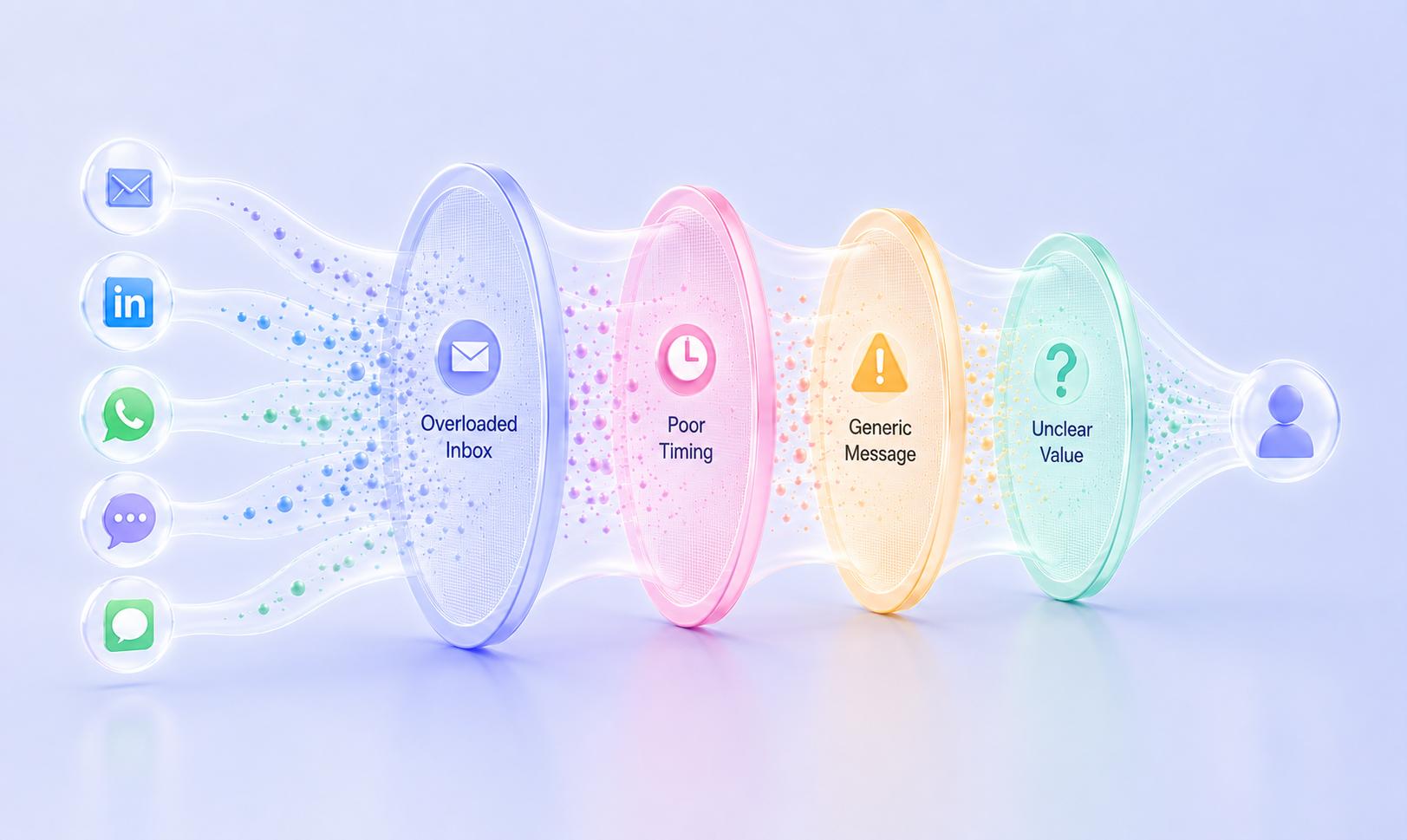
Candidates and clients are being approached constantly, across email, LinkedIn, SMS, WhatsApp and other channels. A message that would once have stood out can now disappear into a crowded inbox within minutes.
So the problem isn't necessarily that recruitment teams aren't doing enough outreach.
It is that the right person may never see the message, or may see it and have no reason to care.
That makes three things increasingly important:
The message. The channel. The sequence.
The message needs to be relevant enough to earn attention.
The channel needs to be somewhere the recipient is actually likely to see it.
And the sequence needs to give you more than one opportunity to be noticed without simply bombarding someone with the same message.
For recruitment agencies, this matters at every level.
It matters when approaching passive candidates.
It matters even more in executive search and senior appointments, where the person you're trying to reach may have little interest in generic recruitment messages.
And it matters in recruitment BD, where an agency is competing with countless other firms for the attention of the same hiring decision-makers.
The data points towards a clear conclusion:
There is no single best outreach channel. The strongest strategy is the one that gives the right person multiple, relevant opportunities to notice you.
The strongest argument for multichannel outreach is surprisingly simple:
You cannot assume someone will see you in the one place you chose to contact them.
A candidate might check LinkedIn every day.
They might not have logged in for six months.
They might live in their email inbox but ignore LinkedIn completely.
They might have hundreds of unread emails but respond quickly to WhatsApp.
A hiring manager might see your email but be too busy to deal with it that day. A LinkedIn message a few days later might be what finally creates recognition.
That is why relying on one channel creates an unnecessary blind spot.
There are plenty of large percentages quoted around multichannel outreach, but many are vendor-specific and difficult to compare because they use different audiences, definitions and methodologies. It is therefore more useful to look at what the individual channels actually tell us.
The evidence does, however, support the broader principle that combining channels can create more opportunities for engagement. The important point for recruitment is that different people behave differently across different channels.
This varies by:
The point isn't to send the same message three or four times.
It's to increase the chances that the right person actually sees you.
There isn't one channel that wins every time.
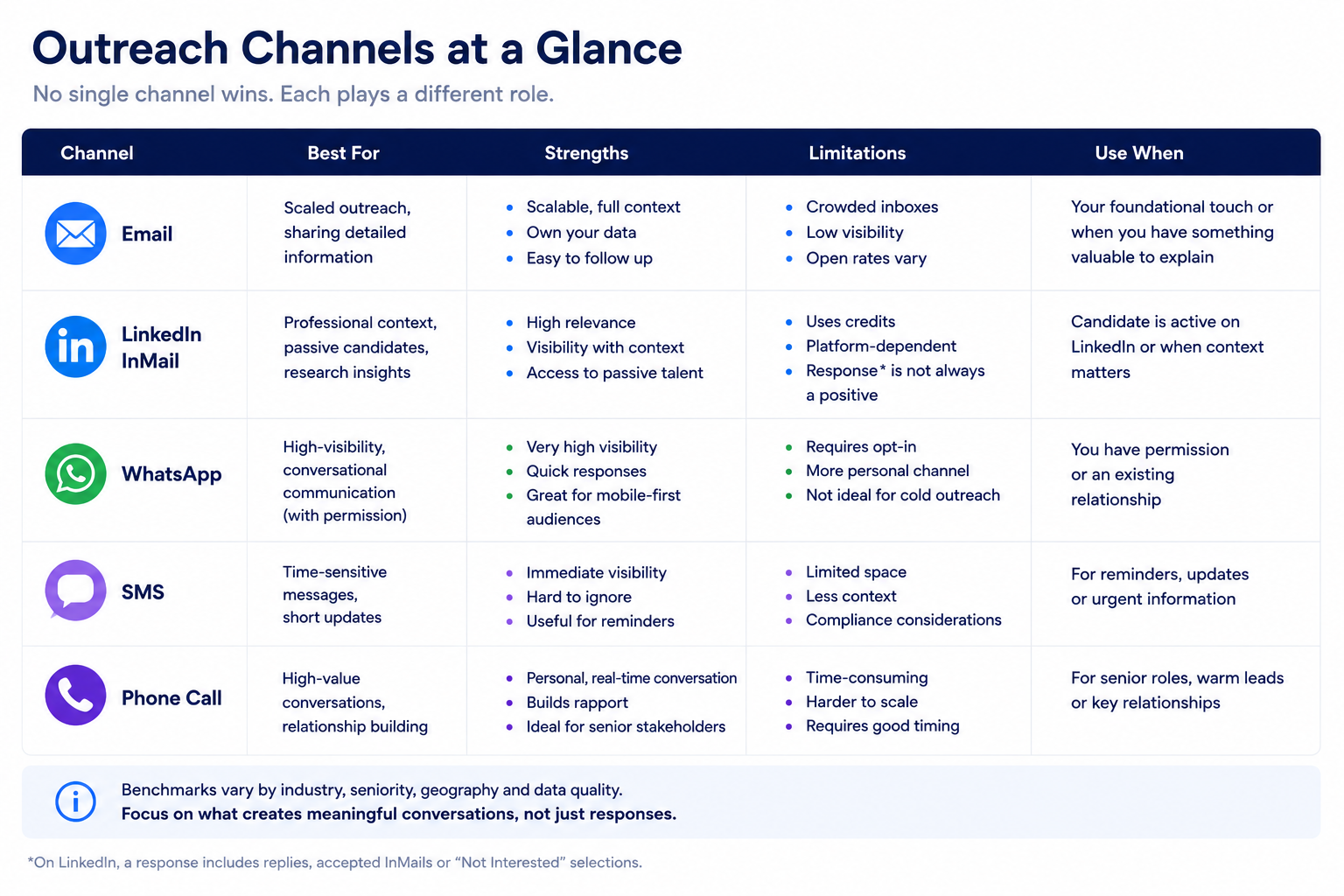
The better question is what each channel is good at, where it falls short, and how it should fit into the overall sequence.
Email remains one of the most scalable ways to reach people directly.
It gives recruiters room to explain why they're contacting someone, it doesn't require a LinkedIn connection, and the agency retains control of its relationship and database.
But inboxes are crowded.
Cold-email benchmarks vary considerably by audience and campaign. More importantly, open rates are becoming a less reliable measure of performance because technical and privacy features can register opens without the recipient actually reading the message.
That means an open should not be confused with attention.
The more useful question is whether the recipient engaged positively with the message.
Follow-up also matters. Large-scale cold-email research has found that a significant proportion of replies arrive after the first message, reinforcing the point that one unanswered email should not automatically be interpreted as rejection.
The lesson is simple:
Getting into the inbox is only half the job. The message still has to earn attention.
LinkedIn is extremely useful for recruitment because it combines professional identity, career history and networking in one place.
But its headline InMail response numbers need context.
LinkedIn has published a 10–25% InMail response benchmark for prospects. That is a sales benchmark, not a recruitment benchmark.
More importantly, LinkedIn's current Recruiter documentation defines an InMail response as an accepted or declined InMail, with its policy specifically including "Not Interested" responses.
So a 20% InMail response rate does not mean 20% of candidates are interested in the opportunity.
It means that 20% have taken an action that LinkedIn counts as a response.
That distinction matters.
LinkedIn also operates through InMail credits and usage limits. Recruiter supports automated follow-ups, but follow-up messages are treated as individual InMails and count towards the response-rate calculation.
There is another practical limitation:
LinkedIn is still one platform.
If a candidate rarely logs in, your carefully written InMail can sit there unnoticed.
That doesn't make LinkedIn a poor channel.
It makes it a channel, rather than the answer to every outreach problem.
WhatsApp is different again.
It sits much closer to someone's everyday communication than email or LinkedIn, which can make it a very high-attention channel in markets where WhatsApp is widely used.
That can be particularly powerful in mobile-first candidate populations.
But the same thing that makes WhatsApp attractive also makes it more sensitive.
An unsolicited recruitment message on LinkedIn may feel like professional outreach.
The same message arriving on someone's personal WhatsApp can feel much more intrusive.
There is also an important compliance consideration. Meta's WhatsApp Business Policy requires businesses to have the recipient's mobile number and the necessary opt-in before initiating business messages, and businesses must honour opt-outs. (WhatsApp Business Policy).
So WhatsApp shouldn't simply become another database for cold outreach.
Used appropriately, particularly once a relationship exists or the recipient has given the necessary permission, it can be an extremely effective high-attention channel.
The lesson is not that WhatsApp is better than email or LinkedIn.
It is that different audiences pay attention in different places.
SMS has a similar advantage: people tend to notice a text quickly.
Industry research has reported significantly higher response rates for SMS than traditional email in some sales environments. However, those figures are not recruitment-specific benchmarks, so they should not be presented as a guaranteed candidate response rate.
SMS is therefore best viewed as another tool in the sequence.
It can be particularly useful when a candidate is already engaged, when timing matters, or where there is an appropriate relationship and the relevant compliance requirements have been met.
This is where the individual channels become more powerful together.
You cannot know which inbox someone checks today.
They may not have opened LinkedIn for months.
They may have 300 unread emails.
They may respond instantly to WhatsApp.
They may see your email but only recognise your name when your LinkedIn message appears a few days later.
The purpose of multichannel outreach is not to bombard someone.
It is to increase the probability that the right person actually notices you.
For recruitment, this is particularly important because there is no single communication behaviour shared by every candidate or hiring manager.
One candidate might ignore your email for three months and respond to your LinkedIn message tomorrow.
Another might never use LinkedIn but reply to email within an hour.
Another might be highly responsive on WhatsApp but consider an unsolicited WhatsApp message inappropriate.
The channel should follow the person, not the other way around.
That is why a recruitment sequence should be able to combine email, LinkedIn, WhatsApp, SMS and other appropriate channels rather than forcing every candidate through exactly the same route.
Absolutely.
In recruitment, particularly executive search, senior appointments and recruitment BD, personalisation can be the difference between someone stopping to read your message and ignoring it.
But there is a big difference between personalisation and personal information.
Adding someone's first name, current company or job title does not automatically make a message personal.
If the same automated message, written in the same tone and using the same pitch, is being sent to hundreds of people, most recipients will recognise it for what it is.
And once a message feels automated, the reader has very little reason to give it their attention.
LinkedIn's own research backs up the importance of genuine personalisation. Its analysis found that personalised InMails performed about 15% better than messages sent in bulk. LinkedIn has also reported that personalised InMails can increase acceptance rates by 40%.
The real differentiator is relevance.
A strong message needs a hook.
Something meaningful about the person, their company, their market or their situation that gives them a reason to stop and think:
Why is this relevant to me?
For a senior candidate, that might be a transformation they have led, a specific project they have delivered, a recent move, a public presentation, a particular area of expertise or a challenge that makes the opportunity genuinely relevant.
For recruitment BD, it might be a change in the company's hiring strategy, an expansion into a new market, a leadership appointment, a new investment, a difficult-to-fill skill set or something you've noticed in their hiring activity.
Compare:
"I saw you're a Senior Engineer at [Company] and thought you'd be a great fit for a role I'm working on."
with:
"Saw your talk on event-driven architecture at [Conference], particularly the migration challenge you described. We're working with a team facing a very similar problem as they scale their platform, and your experience stood out for a reason."
The first message contains personal information.
The second contains personal relevance.
That distinction matters even more at senior level.
A CEO, CTO, Partner or senior executive is unlikely to give a generic recruitment or sales message much attention simply because someone has identified them as a potential fit.
Their inbox is already full.
You need to earn the next 20 seconds.
LinkedIn's own guidance reinforces this point, recommending that recruiters make messages personal and relevant rather than relying on generic, copied-and-pasted outreach.
Personalisation also matters in recruitment BD.
A generic:
"I'd love to introduce our recruitment services."
is competing with hundreds of similar sales messages.
A message that identifies something specific about the company's hiring activity and explains why it is relevant has a reason to be read.
The goal isn't to prove that you've found someone's name on LinkedIn.
The goal is to demonstrate that you understand why this particular person might care about what you're saying.
The exact sequence should depend on the audience.
A senior executive search campaign might start with a highly personalised email, followed by a LinkedIn touch, then a carefully timed follow-up.
A high-volume candidate campaign might use email as the foundation, LinkedIn for additional visibility and SMS or WhatsApp where the relationship and permissions make that appropriate.
A recruitment BD sequence might start with an insight about the client's hiring activity, then use LinkedIn to create recognition, followed by another email containing something genuinely useful.
The channels can change.
The principle doesn't.
Don't rely on one inbox to do all the work.
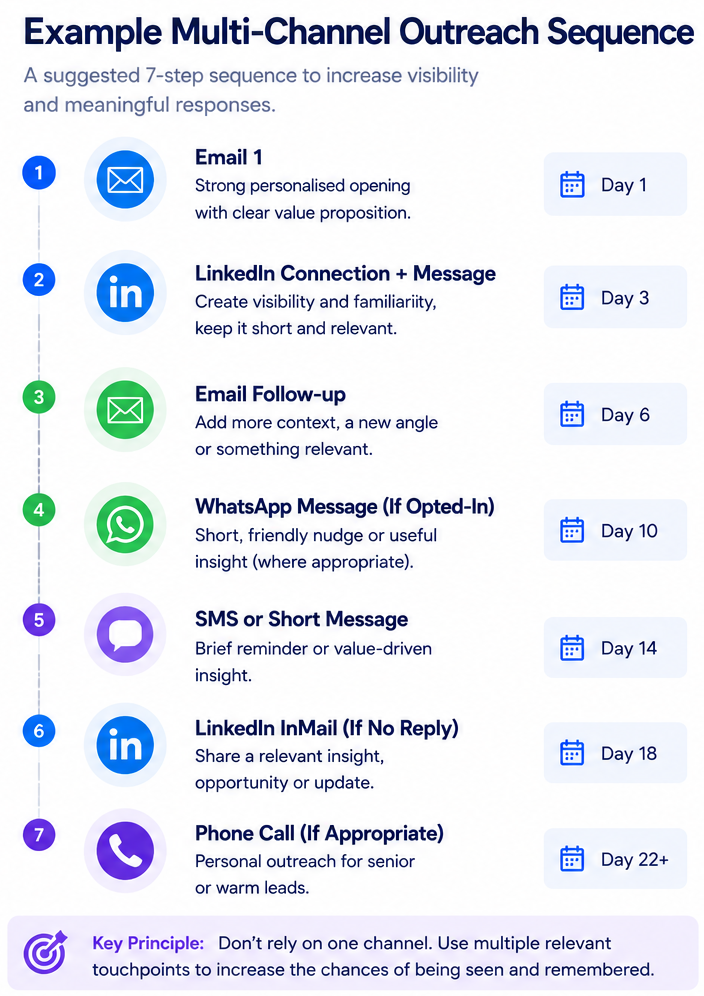
A sensible starting sequence might look like:
1. Email: Lead with the strongest hook and give the recipient enough context to understand why you're contacting them.
2. LinkedIn: Create another point of visibility and familiarity, particularly where the candidate or client is active on LinkedIn.
3. Email follow-up: "Don't simply repeat the first message. Add another relevant reason to engage.
4. LinkedIn follow-up or InMail: Continue the conversation from a different channel rather than copying the email.
5. WhatsApp, SMS or phone: Use the channel that fits the person, market and relationship. For WhatsApp, make sure the required permission is in place.
6. Re-engagement: Come back when something genuinely changes: a new role, a new hiring requirement, a new market development or another reason the conversation has become relevant.
The important thing is that the channels work together. One channel gives you reach. Another gives you visibility. Another gives you immediacy.
The sequence gives you multiple opportunities to be noticed.
Open rates are tempting because they give you a simple number.
But they can create a false sense of security.
An email can be technically opened without being read. Privacy features and automated systems can also affect tracking.
The more useful question is whether the recipient actually engages.
That means looking beyond:
Open rate
and towards:
Positive reply rate → meaningful conversation → interview or meeting → placement or new business
The same principle applies to LinkedIn.
A response isn't necessarily a positive response.
The real measure of outreach isn't how many messages were opened or how many people clicked a button.
It is whether the outreach created a useful conversation with the right person.
The easiest mistake in recruitment outreach is to measure activity instead of outcomes.
How many emails did we send?
How many InMails?
What was our open rate?
What was our response rate?
Those numbers matter, but they don't tell you whether you're actually reaching the people you want to speak to.
A candidate can ignore your email without rejecting the opportunity.
A hiring manager can miss your LinkedIn message without rejecting your agency.
A senior executive can be interested in a move and still never see the InMail sitting in an inbox they haven't opened for months.
No response is not always a "no". Sometimes it is simply "I didn't see you".
That's why the best outreach strategy is not about choosing email over LinkedIn, or LinkedIn over WhatsApp.
It is about creating enough relevant, well-timed opportunities for the right person to notice you.
And every touch needs to earn its place.
The first message needs a hook.
The follow-up needs a reason to continue.
The next channel needs to add visibility, not repetition.
The personalisation needs to demonstrate relevance, not just insert a first name.
And the whole sequence needs to stop when someone engages, not keep firing messages because the automation says "next step".
That is the difference between automated outreach and intelligent outreach.
Automation should handle the repetitive work: finding the right people, managing sequences, switching channels, remembering follow-ups and capturing what happened.
It shouldn't make every recipient feel like they've been added to the same list.
The best recruitment outreach combines scale with relevance.
The first message needs a reason to care.
The sequence needs a reason to continue.
The channels need to work together.
And the measurement needs to focus on conversations and outcomes, not vanity metrics.
Because the goal isn't more messages.
The goal is more of the right people seeing the right message at the right time.
That's the gap between doing outreach and having an outreach strategy.
This is where technology should make a practical difference.
360AI brings multichannel outreach into one recruitment workflow, helping agencies combine the scale of automation with the relevance of personalised communication.
Instead of managing separate tools, lists and sequences across different channels, recruiters can coordinate outreach, personalise messages, manage follow-ups and track engagement from one system.
The objective isn't to automate more messages.
It is to make it easier for recruiters to reach the right people, with the right message, through the right channel, at the right time.
Because when outreach works, the result isn't another statistic on a dashboard.
It's a conversation.
And conversations are what lead to placements, retained assignments and new business.
Sam Aria is the Founder and CEO of 360AI, a real-time talent and market intelligence platform for the recruitment industry. Connect on Linkedin.
This article is a practical market analysis. Any use of personal data for recruitment should be assessed against applicable data-protection, employment and confidentiality requirements.
The claims in this article are supported by the following primary and official sources:


AI built to think like a recruiter.