Last updated: 1 October 2026
Every agency has paid to find thousands of candidates it no longer uses, and then pays again to find the same people from scratch, because the record it already held was so out of date that no consultant thought to check it.
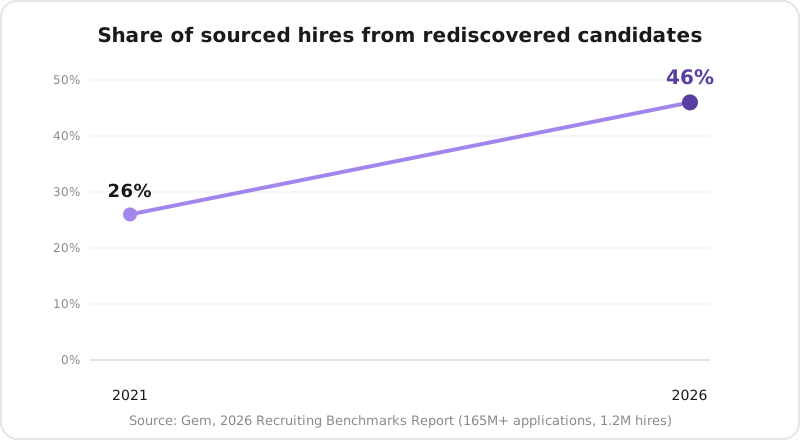
In our conversations with recruitment agencies, the same story comes up again and again: years of candidate history sitting in the ATS/CRM that nobody trusts enough to search first. Meanwhile, the rest of the market has moved the other way: Gem's 2026 Recruiting Benchmarks Report shows 46% of sourced hires now come from candidates already in a company's own database, up from 26% in 2021.
Gem's data comes largely from in-house talent teams, and that's what makes it telling.
Most in-house teams hold far smaller candidate databases than an established agency, yet they now get nearly half their sourced hires from records they already own. If a corporate TA team can do that, an agency sitting on ten or fifteen years of candidate history should be doing better. Most aren't, because they treat that database as an archive rather than a pipeline.
Your candidate database is one of the few assets in an agency that sits on the balance sheet in all but name. Every record in it cost consultant time to find, qualify and log. When nobody trusts it enough to search it first, you pay for that work twice: once when the candidate was sourced, and again when a consultant goes out and finds an equivalent stranger for the next brief.
The damage compounds. Once consultants stop trusting the data, they stop using the ATS or CRM you're paying for, and they stop maintaining it too. Records go un-updated, new ones get logged half-heartedly, and the database keeps growing in size while shrinking in usefulness. You end up paying for a system that holds more and more unreliable data and generates little or no return. Worse, it builds a habit that's hard to break: consultants go to external sources first because they feel more current and reliable, and your own database becomes the last place anyone looks.
When we look inside agency databases, the picture is remarkably consistent: thousands of records, a real person and a real placement history behind each one, and half of them pointing at a job the candidate left over two years ago. Nobody put those records there by accident. They accumulated honestly, one placement and one sourced candidate at a time. Nobody just kept them accurate afterwards.
A simple test for any MD: take the last ten placements your team made and count how many of those candidates were already in your ATS/CRM before the brief landed. Then ask how many your consultants actually found by searching the ATS/CRM first. The gap between those two numbers is margin you've already paid for and left on the table.
A database is a maintained asset or a decaying liability. It's rarely anything in between for long.
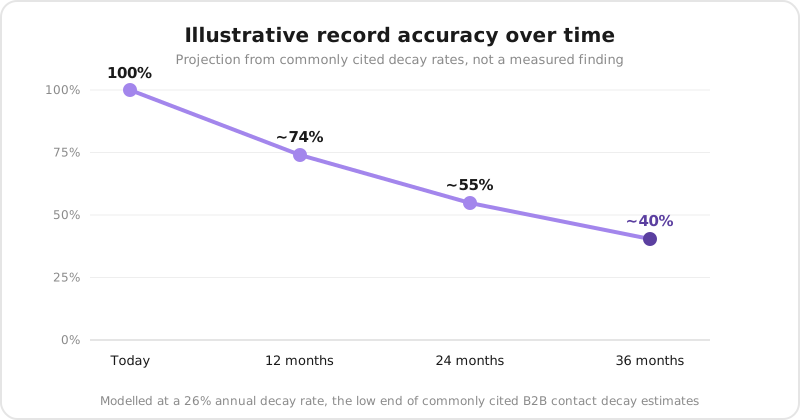
Faster than most agencies plan for. Industry estimates put B2B contact decay at 22 to 30% a year, driven mainly by people changing jobs, with average tenure of two to three years in many sectors. On a database of ten thousand candidates, a 25% annual decay rate means roughly 2,500 records go stale every year, even if your team logs every new record perfectly.
Sales leaders have already noticed. Salesforce's State of Sales 2026 survey found 74% of sales teams are now prioritising data cleansing to get more value from AI tools. Recruitment CRMs face exactly the same pressure, with far less attention on it.
Because at some point, searching it stopped being worth the hit rate. A consultant who tries the database first, gets three bounced emails and a candidate who's been at a different company for a year, learns fast that starting from scratch feels more reliable. That's a rational response to a real problem, and it's also exactly the wrong lesson, because the fix is cleaning the database, not abandoning it.
The irony is that this happens just as the database becomes more valuable, not less. Gem's number nearly doubling in five years means agencies still treating their CRM as the place records go to be forgotten are increasingly out of step with where hires actually come from.
Almost always more usable candidates than expected, and almost always more decay than expected too. A health check that cross-references your records against current employment data typically surfaces three groups: candidates who moved employers without an update, candidates whose contact details have gone dead, and candidates who are still accurate but haven't been contacted in years.
That last group is usually the biggest missed opportunity. A candidate still at the same company, still doing broadly the same work, who simply hasn't heard from anyone in three years isn't a data problem at all. They're a warm lead that's been sitting untouched, and re-engaging them costs a fraction of sourcing an equivalent stranger. For consultants, that means faster shortlists. For the business, it means fees earned on work you've already paid for.
This is a leadership decision, not a consultant task. If nobody owns database health, nobody measures it, and it decays by default. Someone in the business needs to own it, report on it, and treat it with the same discipline you'd apply to your client pipeline.
Keeping records accurate isn't just good business, it's a GDPR obligation. A database health check should also flag records that have passed your retention period, so you can re-engage those candidates with a clear purpose or remove them.
A practical rule of thumb by record age:
None of this argues for abandoning the database and starting fresh, which is the instinct a bad hit rate usually produces. It argues for treating it the way agencies already treat their client pipeline: as something that needs active, ongoing maintenance, not a one-time import that stays accurate forever.
That's the problem 360AI Reviver was built to solve: auditing, re-verifying and reactivating the candidates an agency already holds, rather than treating decay as a reason to write them off.
If your own database's hit rate looks different from what I've described, I'd genuinely like to hear it. Decay rates vary a lot by sector, and a database of senior, stable-tenure candidates ages very differently from one full of high-turnover, early-career roles.
Cleaning records is the starting point, not the prize. Once a database is accurate and kept that way, it opens up three opportunities most agencies are leaving on the table.
1. Placements from candidates you already know. An accurate database is the fastest route to a shortlist. Candidates you've already spoken to, qualified and built a relationship with are warmer, quicker to engage and cheaper to place than strangers found on a job board. Every one you can trust is a potential fee with most of the sourcing cost already paid.
2. Fresh talent flowing in, not just old records going stale. A database that only shrinks in accuracy is a wasting asset. One that is topped up with relevant new candidates every time a role opens keeps growing in value, and gives consultants a head start on every brief instead of a blank search.
3. Business development signals hiding in plain sight. This is the opportunity most agencies miss entirely. When a candidate in your database changes jobs, two things happen: their record needs updating, and the company they just left now has a vacancy. Every leaver is a vacancy to fill. The agency that hears about the move first can call that hiring manager before anyone else, often before the role is even advertised.
4. A proprietary asset that adds to your exit value. Your database isn't only a revenue engine. Kept accurate and actively used, it's proprietary data that no competitor can replicate, and that matters to a buyer. If you can show how much of your revenue comes directly from your own database, through placements made from existing candidates and new clients won from leaver signals, you're demonstrating repeatable, owned value rather than revenue that depends on individual consultants. That's the kind of evidence that strengthens your valuation when it's time to sell.
Your database is one of the most valuable assets your agency owns, and every record goes a little more out of date each month. 360AI's AI Reviver keeps it current, adds fresh talent to it, and tells you when the people in it move.
It works with the ATS or CRM you already use, with zero downtime, no data migration and no need to retrain your team on a new tool. Everything stays as it was, just with fresh data and more intelligence behind it.
Want to know what your database is really worth?
Book a demo and we'll show you how many of your records are still accurate, how many candidates have moved, and where your next placements are hiding.
If your own database's hit rate looks different from what I've described, I'd genuinely like to hear it. Decay rates vary a lot by sector, and a database of senior, stable-tenure candidates ages very differently from one full of high-turnover, early-career roles.
Sam Aria is the Founder and CEO of 360AI, a real-time talent and market intelligence platform for the recruitment industry. Connect on Linkedin.
This article is a practical market analysis. Any use of personal data for recruitment should be assessed against applicable data-protection, employment and confidentiality requirements.
The claims in this article are supported by the following primary and official sources:


AI built to think like a recruiter.