New research into a measurable gap between what candidates write and what keyword search reads
First edition • 8 min read
Why more than 1 in 4 matching candidates never show up in a keyword search, and what that means for how you source.
A 360AI analysis of 363,817 UK profile-role records finds that 27.4% do not contain their own job title in their self-authored profile headline, the exact text a keyword search reads first.
By Sam Aria, Founder and CEO, 360AI - Published: 01 August 2026.
Key numbers
27.4%
of title-matched UK profiles don't contain their own job title in the headline.
14.5%
still don't match, even against a broad, expanded list of related search terms.
36.9%
of CEO-title records don't contain "CEO", the highest mismatch of any group studied.
Steady
Junior, mid and senior professionals mismatch at similar rates, except at the top.
n = 363,817 records across eight roles | August 2026
What is the visibility gap?
The visibility gap is what we call the headline mismatch rate: the share of people whose profile headline does not contain the job title their employment record says they hold.
Here's why that matters. A profile headline is written by the person, for their own reasons. A software engineer who writes "Building things people love" is still a software engineer. A finance director who writes "Ex-Deloitte, now scaling a Series B" is still a finance director. Their employment record carries the title. Their headline does not. A search built to match an exact job title against headline text simply cannot connect the two, however accurate the record underneath is.
To be clear about what this is and isn't: we did not run a live search on any recruitment platform. We compared two fields inside 360AI's own database, resolved current job title against self-authored headline text, for the same people. It is not a test of LinkedIn, Indeed or any named platform, whose search tools typically read far more than a headline. And it is not a measurement of 360AI's own product, which searches the full record using AI and semantic matching rather than matching keywords against a single field, which is exactly why we could build this comparison in the first place.
We studied eight roles chosen to span the white-collar economy: a mix of individual contributor and leadership positions, digital-native and traditional professions, regulated and unregulated fields. This is a deliberately chosen set, not a representative sample of the UK workforce, so read the results as "across these eight roles", not "across the UK market".
Exhibit 1. The eight roles studied, the terms that define each, and why they were chosen.
Role
Term set
Industry context
Why included
Software engineer
Software Engineer
Technology and digital
Among the highest-volume UK tech roles
Registered nurse
Registered Nurse, Staff Nurse
Health and social care
Tests the gap in a regulated, offline-heavy profession
Finance manager
Finance Manager
Finance functions, cross-sector
Core professional role present in every industry
Sales director
Sales Director
Commercial leadership
Heavy recruitment-agency demand
Mechanical engineer
Mechanical Engineer
Engineering and manufacturing
Traditional chartered profession
Marketing manager
Marketing Manager
Consumer and B2B marketing
Hypothesised to skew toward specialism over title
Operations director
Operations Director
Operational leadership, SME
Senior leadership in the SME segment
Data analyst
Data Analyst
Technology, finance, data
Fast-growing role with fluid titling
How often does the headline lack the job title?
In more than one in four profile records.
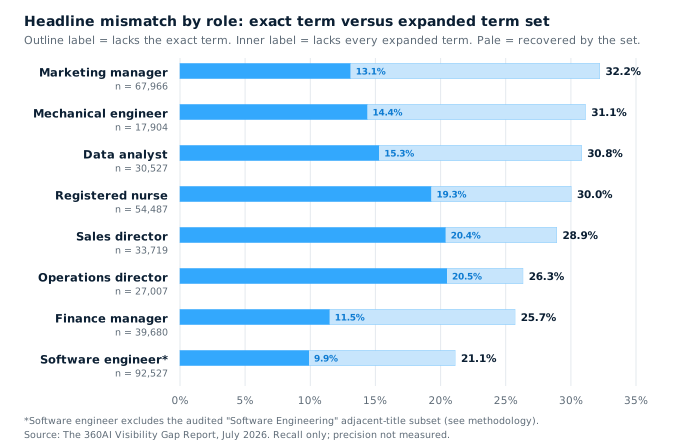
Across the eight roles, the mismatch rate ranges from 21.1% to 32.2%, a fairly consistent pattern for eight unrelated occupations.
Exhibit 2. Headline mismatch by role.
Role
Records
Contains job title
Missing job title
Mismatch
Marketing manager
67,966
46,098
21,868
32.2%
Mechanical engineer
17,904
12,333
5,571
31.1%
Registered nurse
54,487
38,147
16,340
30.0%
Data analyst
30,527
21,121
9,406
30.8%
Sales director
33,719
23,970
9,749
28.9%
Operations director
27,007
19,892
7,115
26.3%
Finance manager
39,680
29,465
10,215
25.7%
Software engineer†
92,527
73,040
19,487
21.1%
Total (adjusted)
363,817
264,066
99,751
27.4%
† Excludes 6,608 records where the job title contains "Software Engineering" (engineering managers and leads), a data-matching artefact rather than a real finding, detailed in the methodology below. Including it gives a raw total of 370,425 records and a 28.5% mismatch rate.
Marketing manager tops the table. Our working hypothesis, not yet independently confirmed, is that marketing professionals more often describe themselves by specialism, "brand", "growth", "content", than by job title. Testing that properly means classifying the text of the mismatched headlines, which is logged as follow-up research.
Does a broader search fix it?
Partly. It roughly halves the gap, then stops.
The obvious objection to an exact-title test is that no one searches a single phrase. So we re-ran every role against a much broader set of related terms, deliberately generous: the software engineer set includes the bare word "engineer", the data analyst set includes the bare word "data". Even with that broader net, 14.5% of the 363,817 records still matched none of the tested terms. Of that, 1.5 percentage points had no headline text at all, and 13.0 percentage points had a headline that simply didn't use any of the words we tested.
Does seniority change the picture?
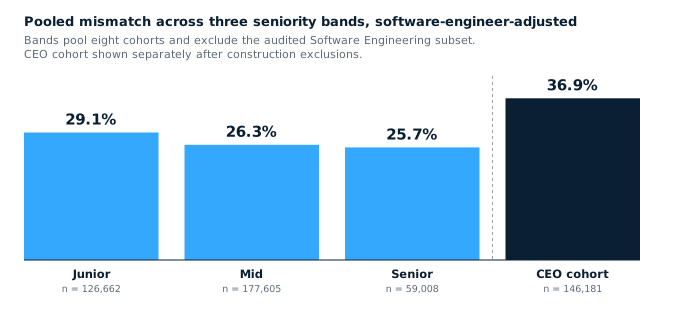
Barely, and not in the direction most people assume. Grouped into junior, mid and senior bands across the eight roles, the mismatch rate is 29.1%, 26.3% and 25.7%, a spread of only 3.4 points. If anything, junior professionals mismatch slightly more often than senior ones, the opposite of what conventional wisdom predicts.
The exception is right at the top. Measuring CEO-title records on their own terms, "CEO" and "Chief Executive Officer", checked in both fields so abbreviations don't distort the count, 36.9% of 146,181 CEO-title records don't contain either term in their headline. That's the highest mismatch rate of any group in the study, roughly eight points above the rest.
Our working explanation, again unconfirmed, is that headlines like "Co-founder and Director" or "Investor, operator, advisor" show up repeatedly among senior leaders, suggesting they describe their standing rather than their function. It's a plausible story. It isn't yet a proven one.
What this means for a sourcing strategy
Read the finding for exactly what it is: across these eight roles, somewhere between a fifth and a third of people don't repeat their own job title in the one field that headline-only keyword search reads. Three things follow.
Know which fields your search actually reads. This gap only costs you candidates if your tools rely on headline text. Searches built on structured title fields, work history or skills are reading different data entirely, and platforms vary widely. Worth checking rather than assuming.
More keywords have a ceiling. Roughly half this gap survives even a generous expansion of search terms. A meaningful share of people simply don't use any of the words a keyword list would contain, no matter how long that list gets.
The durable fix is structural. Match against the employment record, not the way someone chose to describe themselves. A person's job history and current title place them correctly regardless of what their headline says.
How we measured this
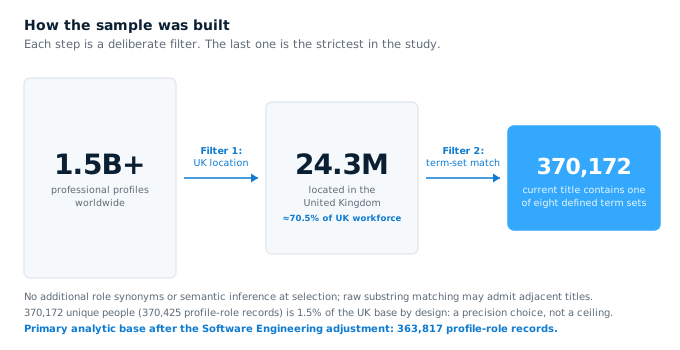
Analysis based on 360AI's database of over 72 million companies and 1.5 billion professional profiles worldwide, filtered to UK-located profiles holding one of eight defined roles: 370,425 profile-role records (363,817 after excluding one identified data artefact) as of August 2026.
We compared two stored fields for the same profiles: the resolved current job title, built from observed employment signals, against the self-authored public headline. No live search was run on any external platform. Matching is case-insensitive substring text matching, applied identically to both fields.
Full methodology, limitations and data tables
What we counted
A profile is title-matched for a role if its current-title field contains one of the role's defined terms as a case-insensitive substring. It's a headline match if the same terms appear in the headline under the same rule. Matching is raw substring text: no stemming, no punctuation or hyphen normalisation, no plural expansion. A blank headline is a null or empty field.
The primary figures exclude two audited artefacts: a "Software Engineering" adjacent-title subset in the software engineer cohort (6,608 records, 88.9% mismatch, almost certainly engineering managers and leads rather than software engineers), and assistant-to, office-of and deputy constructions in the CEO cohort (5,226 records). Excluding the software engineer artefact moves that role's rate from 25.6% to 21.1% and the overall rate from 28.5% to 27.4%. The CEO audit barely moves its figure, 36.8% to 36.9%, which is itself informative: the CEO result is robust to the artefact we could identify. Other roles' substring inclusions (for example "Senior Sales Director") have not been individually audited; word-boundary matching for all roles is planned for the next edition.
Counts are point-in-time reads of a live, continuously updating database taken on 27 July 2026. Identical queries re-run later can differ slightly. The adjusted figures combine morning and afternoon queries and carry an uncertainty of a few records as a result. A single frozen snapshot for every query is planned for the next edition.
What the sample represents
The eight roles are a purposive selection built to span the white-collar economy, not a statistically representative sample of the UK workforce. Results describe these eight cohorts, not the UK labour market as a whole. Coverage is also strongest among people who maintain an active public profile; the registered nurse cohort in particular should be read as a study of digitally active nurses, not the profession, and the size and direction of that bias are unknown.
Limitations
This measures field mismatch, not search outcomes
A missing job title in the headline does not mean a person is unfindable. They may still be reachable through employment history, skills, CV content, referrals, or any search that reads more than headline text.
Recall only, not precision
The expanded term-set condition shows what can be recovered, not what a usable search looks like. Broad terms like "data" or "engineer" would also return large numbers of unrelated profiles in a live search. We did not measure precision or review burden.
Expanded term sets aren't exhaustive
"None of the tested terms" is not "no role words at all". Our lists omit plausible terms, such as "RN" for nurses or "BI" for data analysts, and their breadth varies by role, so cross-role comparisons in that condition should be read cautiously.
The underlying job title field is itself imperfect
Current job title is resolved from observed employment signals and can be stale, mistaken, or based on concurrent roles. We have not yet manually verified a random sample of title resolutions. Some portion of the measured mismatch may reflect data timing rather than self-description behaviour.
No platform-specific claim
We make no claim about the miss rate of any named recruitment platform. Platforms index different fields and populations than this study did, so results will differ.
360AI sells recruitment software
We benefit commercially if you conclude that headline keyword matching is limited. We've tried to earn trust the only way that lasts: every figure traces to a stated query, and corrections made across four rounds of internal review are disclosed rather than hidden.
A. Role-level data
Role
Base
Lacks exact term
Lacks all expanded terms
Blank headline
Software engineer
99,135
25,361 (25.6%)
10,853 (10.9%)
744
Registered nurse
54,487
16,340 (30.0%)
10,520 (19.3%)
770
Finance manager
39,680
10,215 (25.7%)
4,575 (11.5%)
441
Sales director
33,719
9,749 (28.9%)
6,888 (20.4%)
649
Mechanical engineer
17,904
5,571 (31.1%)
2,583 (14.4%)
699
Marketing manager
67,966
21,868 (32.2%)
8,933 (13.1%)
1,091
Operations director
27,007
7,115 (26.3%)
5,539 (20.5%)
442
Data analyst
30,527
9,406 (30.8%)
4,677 (15.3%)
666
Software engineer, excl. "Software Engineering"
92,527
19,487 (21.1%)
9,195 (9.9%)
684
Total, raw (sum of first 8 rows)
370,425
105,625 (28.5%)
54,568 (14.7%)
5,502 (1.5%)
Total, adjusted (primary)
363,817
99,751 (27.4%)
52,910 (14.5%)
5,442 (1.5%)
B. Seniority bands
Band
Status
Base
Contains term
Lacks term
Mismatch
Junior
Raw
128,052
90,100
37,952
29.6%
Junior
Adjusted
126,662
89,766
36,896
29.1%
Mid
Raw
181,222
131,201
50,021
27.6%
Mid
Adjusted
177,605
130,868
46,737
26.3%
Senior
Raw
60,330
43,872
16,458
27.3%
Senior
Adjusted
59,008
43,836
15,172
25.7%
C. CEO cohort
Primary (construction-adjusted): terms "CEO" and "Chief Executive Officer" on both fields, excluding titles containing "to CEO", "to the CEO", "Office of the CEO" or "Deputy CEO" (5,226 records, 34.2% mismatch). N = 146,181; 53,896 (36.9%) mismatch. Raw sensitivity: N = 151,407, 36.8%. A supplementary cohort adding CFO and Managing Director titles gives N = 441,532, mismatch 35.7%; "MD" was excluded as an abbreviation since it commonly denotes a medical doctor in headline text.
About the data
The profile database underlying this study is operated under 360AI's data governance framework; provenance, lawful basis, data subject rights and retention are documented at 360AI's Trust Centre. This report publishes aggregates only, with no individual person or company data. The full aggregate dataset is available on request from 360AI.
Frequently asked questions
What percentage of UK professionals do not mention their job title in their profile headline?
27.4%. In a 360AI analysis of 363,817 UK profile-role records across eight common roles, 27.4% did not contain their own job title in their self-authored profile headline.
Does widening the search terms fix the problem?
Only partly. Even when the search was made far more generous, using an expanded set of related terms per role, 14.5% of profile-role records still matched none of the tested terms. Widening a keyword list closes about half the gap and then stops.
Are senior professionals harder to find with keyword search than junior ones?
No, not meaningfully. Across junior, mid and senior bands the mismatch rate was 29.1%, 26.3% and 25.7% respectively, a spread of only 3.4 points. The pattern does not support the common assumption that seniority makes candidates harder to find by keyword.
Why do CEOs have the highest headline mismatch rate in the study?
36.9% of CEO-title records did not contain "CEO" or "Chief Executive Officer" in the headline, the highest rate of any group studied. As an unconfirmed hypothesis, we suggest this may be because senior leaders more often describe their standing (for example "Investor, operator, advisor") rather than their function.
What roles were included in the 360AI Visibility Gap Report?
Eight roles chosen to span the white-collar economy: Software Engineer, Registered Nurse, Finance Manager, Sales Director, Mechanical Engineer, Marketing Manager, Operations Director and Data Analyst.
Does a headline mismatch mean a candidate cannot be found by recruiters?
No. A headline mismatch means a search that matches keywords only against the profile headline will not surface that person. They may still be reachable through employment history, skills, CV content, employer filters, referrals or semantic search systems that read more than the headline.
Is this study based on LinkedIn or a specific recruitment platform?
No. The analysis compares two fields inside 360AI's own database, resolved current job title against self-authored headline text. It is not a test of any named recruitment platform, and platforms typically index more than headline text, so results will differ by platform. It is also not a measurement of 360AI's own product, which does not rely on headline keyword matching.
How was the data for this report collected?
From 360AI's database of over 1.5 billion professional profiles worldwide, filtered to 24.3 million profiles located in the United Kingdom, around 70.5% of the UK's 34.48 million-strong employed workforce (ONS, 2026), then to 370,425 profile-role records whose current job title matched one of eight defined terms. The primary figures exclude 6,608 records identified as a string-matching artefact, leaving 363,817 records as the analytic base.
Why we built 360AI's AI Headhunter
This report describes the exact problem AI Headhunter was built to solve, so it's fair to say so plainly and let you decide for yourself.
The whole finding reduces to one sentence: a keyword search reads what a person wrote about themselves, and a large share of people didn't write their job title. So we built a sourcing engine that searches the record instead of the self-description. AI Headhunter resolves a person across their employment history, current role, company context and live hiring signals, drawn from over 1.5 billion profiles and 72 million company records, using semantic retrieval rather than matching keywords against a single field.
We're not going to claim it finds everyone; no honest tool sees a person who has left no trace anywhere. What this report supports is narrower: the people a single-field search misses are, by construction, still visible to a search that reads more than one field, and the more of the record you search, the more of that gap you recover. That's the whole argument, and the full data is above so you can check it yourself.
You can take the finding without taking the product. If you run recruitment and this matches something you've seen, or you think our method is wrong, I'd like to hear it. Reply to me directly.
Free to download, no email required. The full report includes the complete methodology and all supporting data tables.
About the author:
Sam Aria is the Founder and CEO of 360AI. He spent years in hands-on recruitment before building the intelligence layer he wished he'd had then. Find him on Linkedin
Last updated: 1 August 2026. Reviewed every six months. Time-sensitive figures flagged for review by January 2027.
Citing this report?
Please attribute it to "The 360AI Visibility Gap Report, 360ai.io, August 2026" and link back to this page.
Suggested citation
For press, newsletters, and AI tools.
360AI. (2026). More Than 1 in 4 UK Professional Profiles Don’t Mention Their Role in the Headline: The 360AI Visibility Gap Report. First edition, August 2026. https://360ai.io/reports/visibility-gap
Suggested attribution
According to the 360AI Visibility Gap Report, 27.4% of 363,817 UK profile-role records across eight selected occupations did not mention their job title in their self-authored headline.
Get started with 360AI
Place great candidates. Find new clients. Unlock your data value.